






Why farming works (and why spring matters)
Most homeowners only sell every several years, and when they do, they tend to call the agent whose name they already know. Farming builds that recognition on purpose: the same neighborhood, the same face and the same useful information arriving month after month. It's slow at first — few agents see meaningful results from one or two mailings — but consistency compounds. Spring is when it pays off. Listing activity typically picks up as the weather warms and families plan moves around the school year, so the homeowners deciding in March and April are reacting to what landed in their mailbox in January and February. Starting your farm in winter means you're already familiar by the time listing season arrives, instead of introducing yourself in the middle of it.
Picking your farm area
A good farm is a neighborhood you can actually win. Look for steady turnover — an area where homes sell regularly enough that there will be listings to compete for. Check competition: if one agent already dominates the signs and mailboxes, a neighboring area may be a better start. Choose a place you know or want to know, because local details (a park, a school, a new restaurant) make your mail feel personal. Then size it to your budget. EDDM is sold by USPS carrier route, roughly 400–800 homes each, so a farm of one to three routes is realistic for a solo agent. It's better to mail 600 homes every month than 3,000 homes once. Before committing, map the routes against the neighborhood boundaries so you're not paying to reach streets outside your target.
Real farming postcard prices
| Item | Quantity | Price (All-In) | Best for |
|---|---|---|---|
| EDDM neighborhood mailer (we print and mail) | 1 USPS route (~400–800 homes) | from $398 | Monthly farm mailings to every address |
| Just-Listed mailed postcards | 500 | $289 | Announcing a new listing to nearby homes |
| Postcards 4×6 14PT | 100 | $59 | Open-house handouts, leave-behinds |
| Postcards 4×6 14PT | 500 | $109 | Door knocking, follow-ups |
| Postcards 4×6 14PT | 1,000 | $129 | Year-round supply for a larger farm |
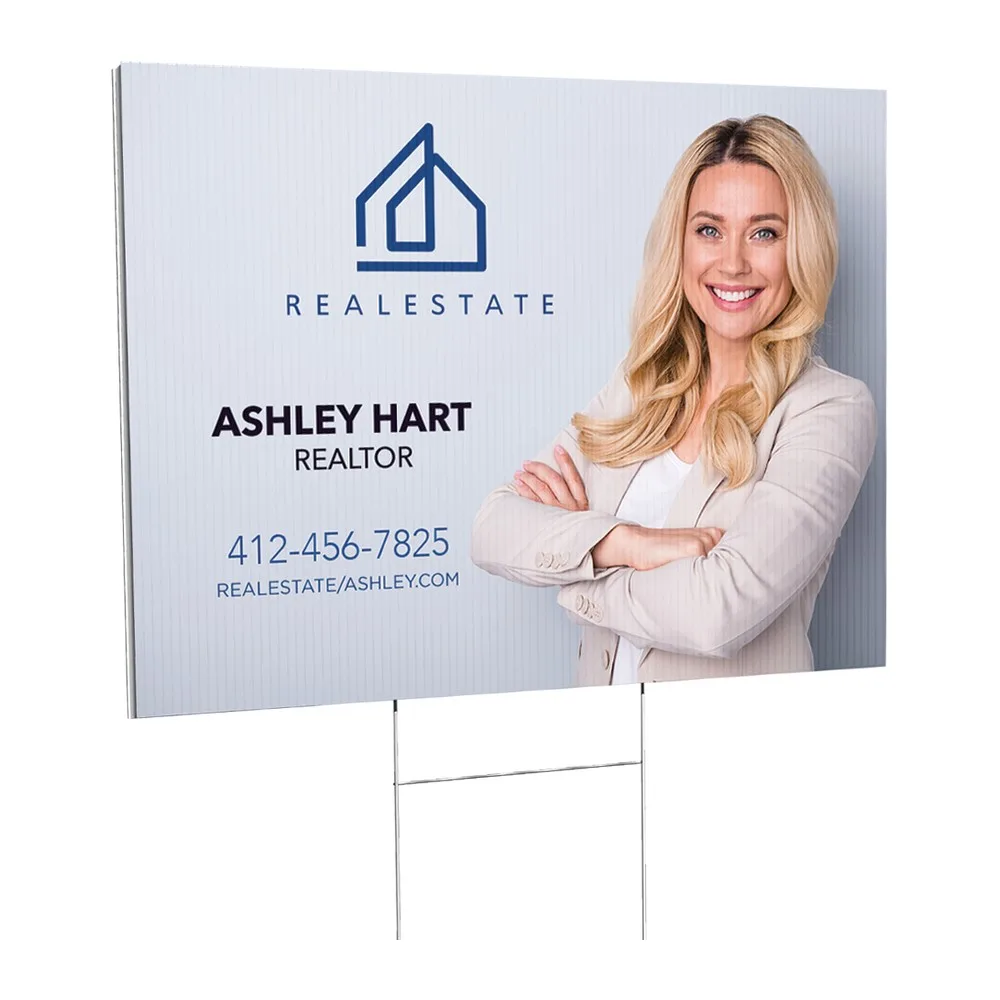
| Yard signs 18×24 with stake | 5 | $109 | Open-house directional signs |
Cadence: what to mail each month
Plan a year, not a single drop. A simple rotation looks like this. January: a year-in-review market update — median sale price, days on market, number of homes sold in the farm. February: a “thinking of selling this spring?” card with a free home-value offer and QR code. March and April: just-listed and just-sold cards as your deals close, plus a spring market snapshot. May and June: sold results and a moving-season checklist. Summer and fall: quarterly market updates, a community event card, and a seasonal card homeowners actually keep, like a local events list. December: a simple thank-you or new-year card. Monthly is the minimum for real recognition; some agents add extra just-listed drops when inventory moves. Keep your photo, name, brokerage and contact info in the same spot on every card so each mailing builds on the last.
Just-listed, just-sold and market update cards
These three card types do different jobs. Just-listed cards create urgency for nearby neighbors who may know a buyer, and they show the farm that you're active — Just-Listed mailed postcards run $289 for 500. Just-sold cards are your strongest proof: lead with the result (“Sold in 9 days” or “Sold over asking”), only when it's true and your brokerage rules allow, and invite neighbors to ask what their home is worth. Market update cards give homeowners a reason to keep your mail instead of tossing it: three or four local numbers, a short line of context and one call to action. Keep every card scannable in a few seconds — big headline, one photo, one offer. EDDM pieces must meet USPS flat-size rules, so they're larger than 4×6; 4×6 cards work for handouts and addressed follow-ups.
Making the farm pay off
Track every response: give each campaign its own QR code or landing page so you know whether market updates or just-sold cards drive more calls. Back the mail with in-person touches — door knock with a 4×6 card the week a mailer lands, and put directional yard signs out for every open house. Expect the first few months to be quiet; most farms take a sustained run before calls become regular, which is why budgeting for a full year matters more than the size of any single drop. If you don't have designs, a matching three-piece set (market update, just-listed, just-sold) is $189 from our design team, with the first proof within 2 business days. Every order includes a free file check and a free digital proof, nothing is charged until you approve, shipping is included, and if we get it wrong, we reprint it.
All-in pricing. Free proof. No checkout surprises.
Start your spring farm — EDDM from $398 per route, printed and mailed, free proof first.
Start your spring farm — EDDM from $398 per route, printed and mailed, free proof first. ⚡ Or build a full kitFrequently asked questions
What is real estate farming?
Real estate farming is mailing and marketing to the same neighborhood consistently so homeowners recognize an agent when they decide to sell. It usually combines monthly postcards or EDDM mailers with door knocking, open houses and local yard signs.
How often should I mail my real estate farm?
Monthly is the minimum most agents use to build real recognition, with extra just-listed or just-sold mailings when deals move. Consistency over a full year matters more than the size of any single mailing.
How big should a real estate farm be?
For a solo agent, one to three USPS carrier routes, roughly 500 to 1,500 homes, is a realistic starting farm. It is better to mail a smaller area every month than a large area once.
How much does real estate farming with EDDM cost?
At i Can Print That, EDDM neighborhood mailers start from $398 per USPS route, with printing and mailing prep included. Just-Listed mailed postcards are $289 for 500, and 500 4×6 postcards for handouts are $109.
When should I start farming for the spring market?
Start in January so homeowners have seen your name several times before listing activity picks up in spring. A January market update and a February home-value card set up the March and April listing season.